American Goldfinch DSLR video; filmed in Cape May, New Jersey

It was a real treat to get some close footage of our vibrant state bird recently.  I knew that I would want footage from several different angles to create diversity… even in a short wildlife video.  Varying the focal lengths and my angle of view on the birds was how I tackled that challenge.

Footage shot in 1080p at 30fps on the Canon EOS 7D with the tripod mounted Tamron SP 150-600mm VC zoom lens.  DSLR was set to the desired shutter speed of 1/60th of a second and I adjusted the aperture and ISO value to get as good of an exposure as possible for each clip.  Unfortunately it was a windy day so I had to strip the audio of the birds interacting and feeding.  I don’t think anyone would have enjoyed listening to the hissing and popping caused by the wind hitting the microphone outdoors.
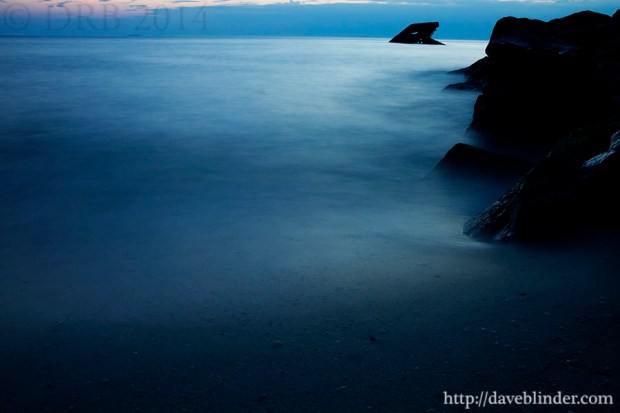
Dusk at Sunset Beach

I was doing nature photography in various parts of Cape May this past Thursday, and had a gameplan to head to the well-known Sunset Beach area to try to make some photos of the setting sun.  My plan was foiled as the horizon clouded over as the sun began descending closer and closer to the horizon.

Cape May Dusk

A recent long exposure photo taken in Cape May, New Jersey.

With a fairly bleak sky I shifted my attention and tripod-mounted camera downwards to try to capture the water motion near the tideline.  For this capture, I have a circular 3-stop Neutral Density filter attached to my Tamron 18-270mm VC lens to allow more time for motion within the frame.  The resultant exposure time here was 30 seconds with an aperture of F/13 to have an expansive depth of field.  The ISO value of 100 provides the best image quality possible on current DSLR cameras.

The composition in this image incorporates the rule of thirds to draw the viewer in.  The dark rocks of the jetty occupy roughly 1/3 of the horizontal width of the frame and the sky occupies approximately 1/6 of the vertical height of the frame.  The misty water occupies the vast majority of the scene, but the rocks and the sky give a sense of scale and environment to the scene.

Wildlife Filming Equipment

Wildlife Filming Equipment

Tamron 150-600mm VC Telephoto Lens
Canon EOS 60D
Rode VideoMic GO microphone (just purchased from Unique Photo in Fairfield NJ)

Equipment used for shot:
Canon EOS 7D DSLR Camera.
Tamron 90mm VC Macro Lens.
Cowboy Studio Fluorescent Light + Window Light

Lies brand t-shirt photoshoot

DRB Photo Gear

Dave Blinders Strobes, Camera, and Lens

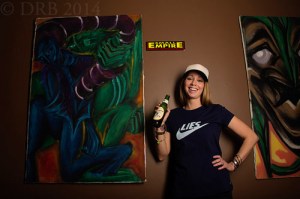
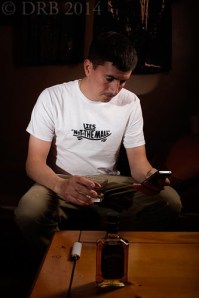
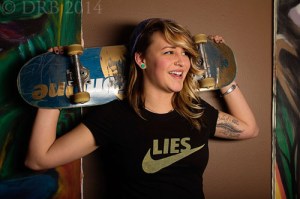
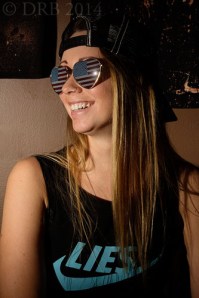
I did a quick inpromptu photoshoot last night in Northern New Jersey for my friend Joe who runs his own small skateboarding T-shirt business in his spare time. Knowing in advance that I’d be working in close confines, I thought one Alien Bees AB800 Strobe with a stripbox style box, a Canon 580exII with Opteka grid, my Canon 60D dslr, and Tamron 18-270mm VC lens would allow me plenty of diversity and lighting and composing options.

rimlighting portraiture by drb

Joe in rim lighting

Tamron 18-270mm VC, Canon 60D, and gridded 580ExII off-camera to subject’s left

girls holding skateboard

Korynne and Carmela holding skateboard deck

Tamron 18-270mm, Canon 60D, and AB800 w/ stripbox angled slightly from camera right

man in skate tee

Joe wearing his own branded T-shirt

Tamron 18-270mm Lens, Canon 60D, Gridded Canon 580exII Speedlight angled from slightly above subject

girl in skateboard t-shirt

Korynne in navy blue Lies T-shirt

Tamron 18-270mm VC, Canon 60D, AB800 strobe slightly above and right of subject

man in skateboarding t-shirt

Joe wearing one of his designs in white

Tamron 18-270mm VC Lens, Canon 60D, Gridded 580exII Speedlight aimed towards subject’s chest, AB800 on minimum power from subject’s right

girl in skateboard t-shirt

Carmela wearing black Lies t-shirt

Tamron 18-270mm Lens, Canon 60D, AB800 in stripbox slightly above and right of subject

girl in skateboard tank top

Korynne wearing blue Lies tank top

Tamron 18-270mm VC Lens, Canon 60D, 580exII Speedlight w/ Opteka Grid coming in from camera left

If you have any questions about the equipment, techniques, clothing line, or contacting the models please leave your information in the comments section or contact me via facebook.

Self-Critique on a photo I took today

Image

From a VERY quick walk in this frigid weather.

Instinctively, I critique all of my photos on a technical and compositional basis when I review them.

Sometimes I notice things I couldn’t see through the viewfinder. In this particular shot, the small brown blur towards to the top left is an “error” in my opinion. It’s probably a distant dead leaf, and I feel it detracts a bit from the photo.

I would have removed it physically if I had noticed through the viewfinder. However, I do not like to alter my nature shots in post-processing, and I prefer not to crop. I do my best to present the scene as it was. I did though, move the feather from a pricker bush on the ground, to an elevated and isolated branch to make the shot. It blew away seconds later and I’m lucky I got a shot at all.

I did shoot a few frames at an aperture of F/4 also (presented shot is F/2.8).  The increased aperture brought nice detail into the feather, however I did not like the background elements that starting coming into focus.

Minimalism in Nature

Went for a walk in one of my favorite nature areas in New Jersey yesterday morning, Mahlon Dickerson Reservation in Jefferson.  Optimistically, I had a wildlife lens mounted, and my macro flash unit also ready to go for smaller critters.  However, no opportunities like that materialized for me.

I noticed a bare sapling near the mostly frozen stream’s edge, and originally thought I’d isolate the entire sapling against the simple background.  I shot a few broader frames, but felt they all lacked any prominent shapes or visual guidance.  I zoomed in a bit with my zoom lens and also my tripod to see how this small single branch with a nice diagonal orientation and prominent juttings could possibly fill the frame.

I liked the frame, but the remaining problem was one unsightly rock just barely jutting from the ice’s surface.  Next step was locating a leaf in decent shape, and using a stick to push it into position to mask the rock.  Little did I know, the now juxtaposed leaf would become my favorite part of the shot.  A polarizing filter was also necessary to remove glare, especially since a small layer of melt water was sitting on top of the ice and reflecting sunlight and the surrounding trees.

New Jersey Nature Photo

Branch, Ice, and Leaf

Tamron 18-270mm VC lens @ f/16, 1/20s, ISO 200 on a tripod mounted Canon 50D.  Mirror lock-up and camera timer used to maximize sharpness.

,,,

Self-portrait with Strat

I dusted off my Alien Bee’s AB800 strobe to prep for some portrait work, draped my black muslin over my backdrop holder, manually pre-focused my 17-40mm lens (very small working conditions), and was happy to come up with this self-portrait.

DRB 2013

Self-portrait with Strat

I’m actually sitting on an unseen stool here, so that was what I prefocused the lens on.  I thought I’d try a pretty stark sidelighting angle with the AB800 angled slightly downward on camera left to create a “masculine lighting effect”.  I do have the diffused beauty dish adapter, so I left that mounted on the AB800.  I’m happy that there was not much light spilling on the background, which helps contribute to the somber and mysterious mood of this image.

One of the best parts of shooting on black is not worrying about background exposures!


Technique: Framing a sunrise

A fairly basic photo, but hopefully it has enough going for it to make viewers look twice.

First of all, I went to a section of the beach where I anticipated possible foreground elements to create a multi-dimensional image. I set my alarm so that I’d have some time to spare before first light came above the horizon, made sure I had my essential camera gear, grabbed a flashlight, and made the short drive over to the beach.

NJ Shore sunrise photo

Gnarled Tree and Sunrise

I walked past this interestingly twisted dead root as soon as I neared the beach, and made a mental note that I could try to incorporate it into my scene. I continued to scout around for a few minutes after that, but realized that I probably wasn’t going to be able to beat the character of the root.

I set my tripod to a pretty low level so that the widest part of the root would not converge with the horizon for this frame, and I will admit to snapping off a vertically extending portion of the root to make sure it would fit into the photo. Another important part of this photograph is the sunburst effect, which I know is generally best achieved with my lens/DSLR combo at an aperture of F/22. I’ve found that having the sunburst disperse across a solid object to help amplify the effect, and I knew that I wanted to frame the sun within a portion of the root to further draw the viewer’s focus to the sun itself. That took some fine movements of the tripod to get things just right.

I also shot some horizontal frames before the sun came above the horizon, and will upload and possibly discuss those later this week.

My Personal View on Post-Processing

I read a lot about “must have” post-processing programs and plug-ins to “get the most out of photography”. I think the trends like adding background textures, post-processing blurs, and over-the-top HDR programs will eventually go the way of the Dodo.

Do you think Ansel Adams would have benefited from importing someone else’s floral patterns behind his powerful mountain images with often ominous storm clouds? Probably not. Did he go beyond basic post-processing? Not really (mostly what I consider rudimentary contrast enhancements). Does his photography have some of the greatest longevity we’ve yet to see? Of course!

Bird photo

Ruby-crowned Kinglet

If I don’t see semblance of a compelling image through my viewfinder or in the Camera Raw preview, I simply move on, and try to compose better next time I shoot.

Just my two cents.

Using a Neutral Density Filter to Enhance Motion

This photo was taken on an overcast morning so a slow-ish shutter speed was inevitable. However, I really wanted to emphasize the motion in the flow of the water, so I mounted my 3-stop neutral density filter which allowed for a shutter speed of 8 seconds at F/16 ISO 100. The lens used was my Tamron 18-270mm VC, at 18mm.

New Jersey Scenery Photo

Rockaway River and Footbridge

Long exposures like 8 seconds are a matter of taste, but I love the painterly effect it can give. I find that the majority of ND filters on amazon are decent quality, and I usually don’t spend much more than $20 on mine.