New Jersey Nature Photography: Ice Detail #2

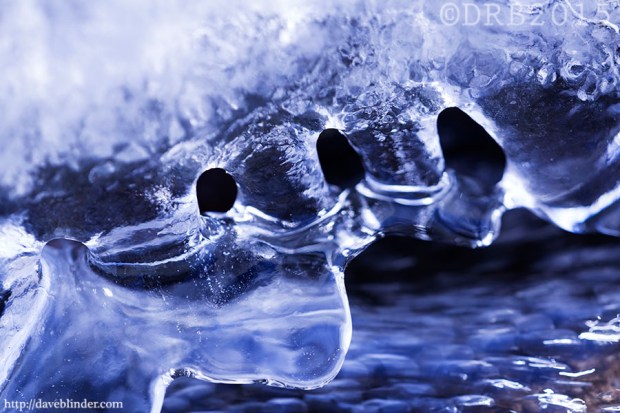
I braved the cold front for a bit on New Years Day, and headed out with my Tamron SP 180mm macro lens and Canon 6D to see what I could see.  After I began shooting, I realized that my camera’s White Balance was set to Florescent due to some indoors video I had previously been shooting.  More often than not, I will use Auto White Balance for shooting stills (in Raw format).  While White Balance is easily changed during Raw processing, it affects the “mood” of my initial photos as I glance at the previews on my LCD.

In this case, I not only liked the cooling effect of the manual White Balance on my subject matter, I loved it.  Improper WB’s can often render photos as unrealistic, but there are certainly times and places for creative WB usage.
NJ Nature Photo

Ice Detail 2. New Jersey #Nature Photo taken handheld with the #Tamron SP 180mm F/3.5 macro lens and the Canon EOS 6D.

Exposure Settings: 1/160 F/4.5 ISO 200, 180mm
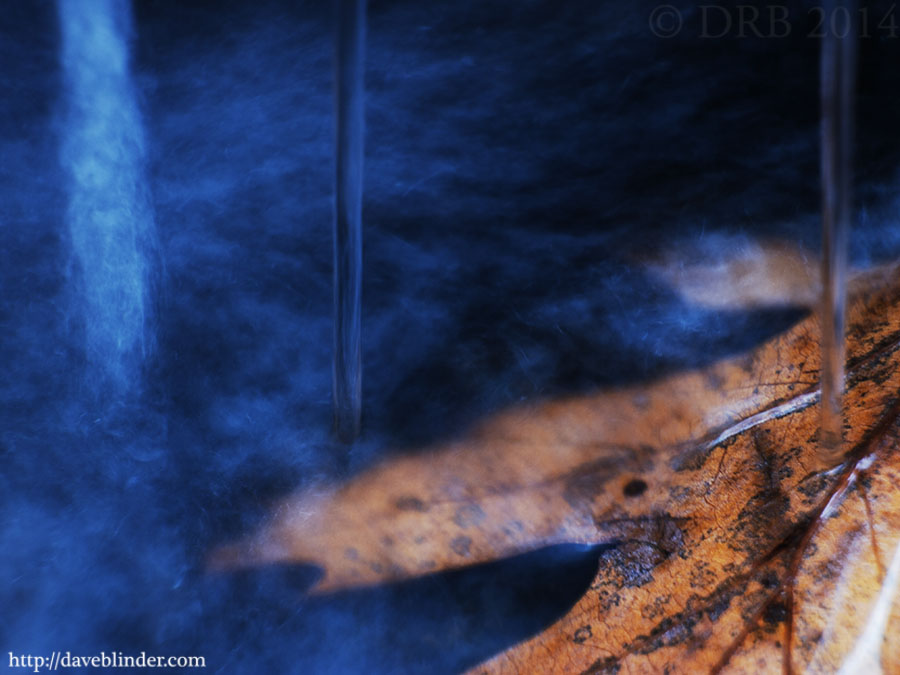
New Jersey Nature Photography: Water Falling on Leaf #1

Yesterday, while out doing local nature photography in Morris County, New Jersey, I decided to pair my Tamron 14-150mm Di III All-In-One lens with a set of Meike MK-P-AF3B extension tubes to my Olympus PEN EPL3 micro four thirds camera.  The purpose of the extension tubes was to allow the lens to focus closer than normal.  The main drawback of tubes is always the loss of infinity focus.

Below is my favorite shot from yesterday morning, and an uncropped one.  It always becomes a visual exploration for me to photographically capture little segments of nature, especially with moving elements like water.  The weathered Oak Leaf was a great secondary element, located just under the trickles of water.  The trickles were falling off a mossy rock in a slight bend in the stream.  Post-processing on the photo included a slight creative white balance shift, and also some reintroduction of contrast to the RAW file.

NJ Nature Art

A closeup photo of three small trails of water descending around an old Oak Leaf in #NewJersey. Picture taken with the #Tamron 14-150mm All-In-One Lens, Meike AF extension tubes for close focus, and the #Olympus PEN E-PL3 micro four thirds camera.

Exposure settings: 1s F/9 ISO 200, 132mm

Equipment used:
Tamron 14-150mm Di III All-In-One lens

Zeikos 52mm circular polarizing filter

Meike MK-P-AF3B extension tubes

Olympus PEN EPL3 m43 camera

Manfrotto 488RC2 ballhead

Benro carbon fiber tripod

For a quick look at the camera and lens setup, view on my Instagram account – http://instagram.com/p/wl108iKs_J/

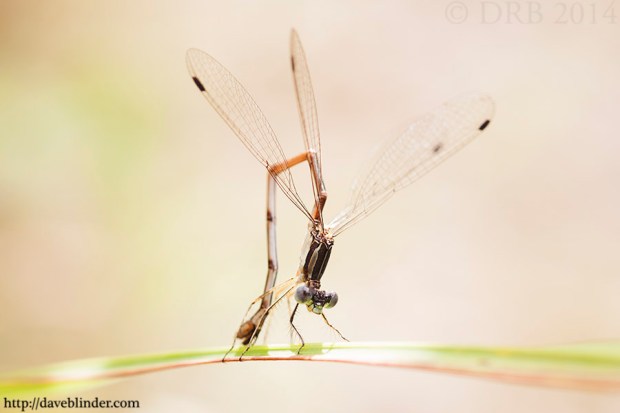
Study in Form: Spotted Spreadwing

In the warmer months, I do devote a good amount of my time to photographing Odonates here in New Jersey.  Odonata is the order of carnivorous flying insects including dragonflies and the more slender damselflies.  They come in a great deal of shapes and dazzling colors, making for eye-catching images.  A straightforward but uncluttered capture of a dragonfly or damselfly can have great impact, but occasionally a person may be lucky enough to image their aerial acrobatics or land contortions.

 Lestes congener

A lucky photo of a Spotted Spreadwing damselfly in a greatly flexed position.

A distant background, clear foreground, and attractive perch set the stage for a very minimalistic frame.  The damselfly obliges by pausing for a moment in the shape of the letter “n”.  Looks like it may be ovipositing (attaching eggs)?

Photo taken with the Canon EOS 50D DSLR and the Tamron SP 90mm VC macro lens.  Handheld photo taken at 1/80 F/5 ISO 200.

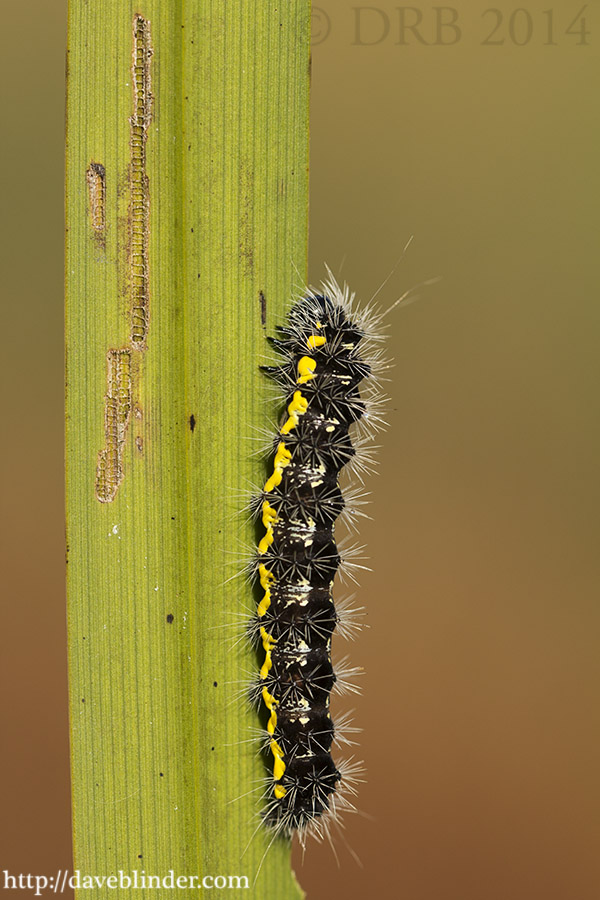
Macro Photography: Smeared Dagger Moth Caterpillar

This photo was taken two days in Morris County, New Jersey.  My typical daytime macro setup of the Tamron SP 90mm VC 1:1 lens and Canon EOS 60D was used handheld.  I do like to use a tripod as much as possible, but a paper-thin blade of grass blowing in the wind becomes an even more difficult target from a tripod.

Acronicta oblinita

An isolated view of a caterpillar with a contrasty yellow and black coloration photographed in portrait orientation.

A sharp frame after two or three DOZEN attempts at squaring up to the blade of grass, getting the camera sensor fairly parallel to the caterpillar, getting my composition locked in, and eliminating motion blur within the frame.  If you are going to bother trying to take a snapshot, you might as well take the time to make sure you’ve applied all of your skills and knowledge to the shot.

1/250th F/5.6 ISO 200 in Manual Exposure mode.

Critical Focus in Photography: Spotted Orbweaver

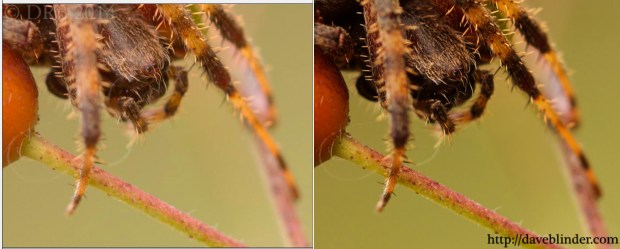
It is a widely accepted concept in people photography and wildlife photography that getting the eyes of the subject sharp will make or break a photo.  One obvious exception being abstract photography.  In can be pretty tough to gauge sharpness on macro critters, and it is not easily achieved in outdoors field photography.  By my estimations, I take at least one dozen shots of each composition while looking through the viewfinder and being thoughtful of my shutter speed to get the photo I am after.

Araneus diadematus

A magnified view to aid in image sharpness checking. RAW preview on left and optimized JPEG on right.

A composite image shows one of the few frames that met my sharpness standard for this capture of an Orbweaver spider.  It is not blurry before processing and it is not blurry after processing.  The main changes are contrast enhancement along with light noise reduction and global sharpening.

New Jersey spider picture

An outdoors spider in New Jersey, photographed handheld with the Tamron SP 90mm VC and the Canon EOS 60D.

Above we see the full view of my macro photo in its native 3:2 aspect ratio with no cropping performed.  Using my 60D and Tamron 90mm VC, I manually exposed with settings of 1/100th F/4.0 ISO 200.

Rethink the most obvious shooting angle: Green-striped Darners

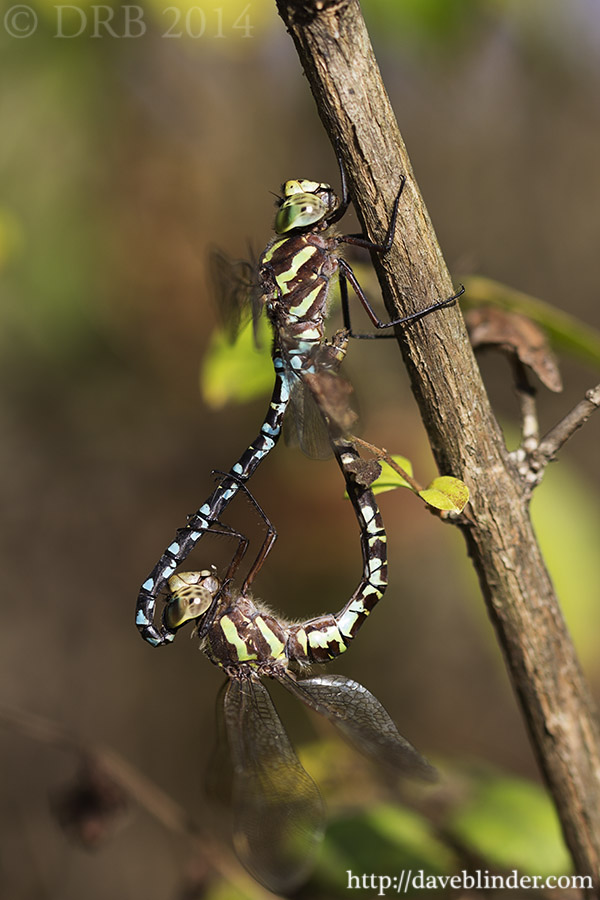
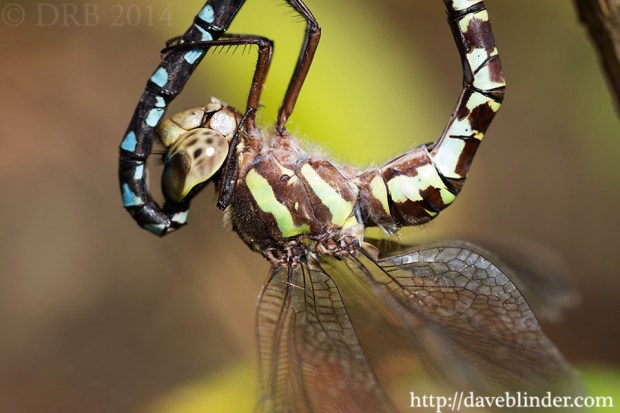
Photos taken yesterday in Sussex County, New Jersey.  I was actually trying to take a macro shot of a caterpillar in the shade (quite frustrating) when I saw these two large dragonflies in the mating wheel position fly near me and land.  I approached slowly with macro lens in hand and got very lucky that they were not startled off.  Haven photographed insects quite a bit the past few years, it’s only natural to look to capture them both together in the same frame without having any of their appendages extend beyond the frame.

Shot #1:

macro odonata photo

A few of a male and female darner in a typical reproductive pose. Photo taken in Sussex County, New Jersey with the Tamron SP 90mm VC F/2.8 Macro Lens and the Canon EOS 60D DSLR.

Metadata: 90mm, 1/640th F/3.2 ISO 100, handheld with VC.  Manual Exposure.

I NEARLY walked away haven taken a pretty sharp frame, but I thought “what the heck” why not try a true macro photo with high magnification on one dragon’s face.  It took 1 or dozen frames to get a handheld shot in focus at that magnification, but to me it created a photo with a much higher “wow” factor.

Photo #2:

macro odonata face photo

An intimate view of a Green-striped Darner showcasing vivid lateral coloration. Photographed with the Tamron SP 90mm VC Macro Lens + Canon EOS 60D in NJ.

Metadata: 90mm, 1/100 F/5.0 ISO 100, handheld with VC.  Manual Exposure.

It is certainly subjective to which shot is “better”, but the 2nd is more to my liking.  By rethinking about possible compositions I have 2 drastically different photos of the same subject taken a minute or two apart.  Quality nature photography is seldom performed in a hurry.  I have always been an advocate of the phrase “haste makes waste”.

Exposing for backlit photography subjects: Orange Sulphur

I am generally a fan of semi-automatic exposure systems when looking to photograph wildlife.  Specifically, I begin most outings with the camera in Aperture Priority Mode, and having an extra 2/3 stops of lights dialed seems to work pretty often.  However, as soon as I see a tricky lighting situation through my viewfinder I will try to get into Manual Exposure Mode as quickly as possible.

NJ Wildlife Photo

A macro photograph of an Orange Sulphur butterfly in New Jersey. This backlit capture was made using the Tamron SP 90mm VC 1:1 macro lens and the Canon EOS 60D DSLR.

Camera settings: 1/200th F/5.6 ISO 200

Above photo is a handheld capture with one of my typical rigs for closeup photography, the Tamron SP 90mm VC lens and the Canon EOS 60D.  The goal with this backlit photo was to get a good amount of illumination showing on the butterfly itself.  To achieve this, some of the brightest parts of the scene are pushed out of gamut because of the dynamic range restrictions of DSLRs.  As cameras are programmed to expose for the median tonal range of an image, it would require a significant increase in exposure compensation to get what I was after.  Turning the knob to Manual Mode and dialing in my desired settings was a much more succinct process.

“Blowing out the highlights” is not always a sin in my book, as I’ve learned to “see how a camera sees” and envision the end product.  Indeed there is some detail loss on the fringes of the butterfly and also on the petals of the flower, but in this case I think that adds to the “warm” feel of the image.

Pandora Sphinx Moth Caterpillar

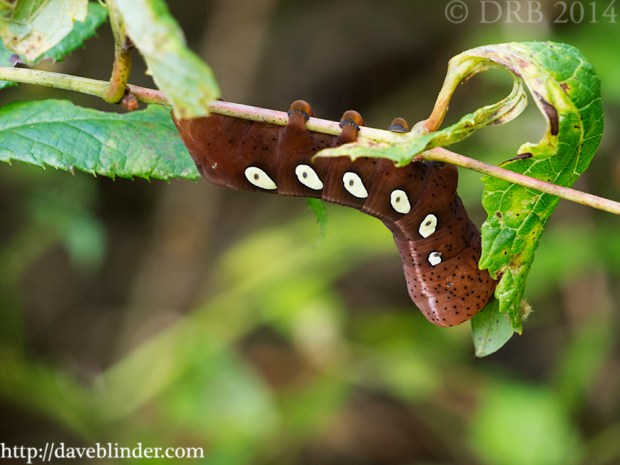
This photo was taken recently in Morris County, New Jersey.  I can’t identify many caterpillars “off the cuff”, and I was pretty sure this was one I had never seen before.  Whenever possible I put some effort into putting the proper common name to any insect, bird, or plant that I take pictures of.  The hardest IDs for me are moths and nondescript plants.  Often I will “throw in the towel”, and ask someone else for help in identifying the organism.  My Google Search for “brown caterpillar with green spots” eventually led me to a dead ringer for this one, a Pandora Sphinx Moth Caterpillar, luckily for me a distinctive larva.

Eumorpha pandorus photo

Micro Four-Thirds photograph of a large brown and green caterpillar feeding.

Photo taken with the Tamron 14-150mm f/3.5-5.8 Di III Lens and the Olympus PEN E-PL2 Micro Four-Thirds Digital Camera mounted on my Manfrotto 055xProB tripod.  Settings: 150mm focal length, 1/20th shutter, aperture at F/8, ISO 400.  One Shot focus with continuous motor drive, Image Stabilization Mode 1 (in camera), RAW image format.  Less than 5% of the image was cropped off because of a very distracting leaf hitting the frame of the image.

I prefocused the lens on some nearby leaves, which allowed the lens to find the caterpillar faster than going through its entire focal range.  My subject was pretty stationary and I felt confident that I had a few moments to spare so I bent down a couple of leaves in the background to eliminate a little clutter.  I’d still prefer better separation from the background and foreground, but such is the way of nature photography, you take what you can get and make the best of it.

Butterfly Photography: An American Copper

Several of our local species of butterflies like to rest on whatever flat surface they can find.  I often see butterflies in the middle of dirt trails, dirt roads, and gravel roads.  Probably a nice place to bask for a cold-blooded life form, but not necessarily the ideal scene for a photograph.

Lycaena phlaeas

A closeup view of a small and interestingly marked native butterfly of New Jersey.

DSLR photo of an American Copper butterfly using the Tamron SP 90mm VC 1:1 F/2.8 Macro Lens and the Canon EOS 50 DSLR.  Camera settings in Manual Exposure Mode: Shutter at 1/50th Aperture at F/5.6 and ISO 200.  Autowhite Balance is selected (my typical default), RAW file size, One Shot focusing in Continuous Drive Mode.  VC (in-lens stabilization) On.

This dainty insect is actually sitting on an unattractive dirt trail here, but the camera’s angle of view disguises the surroundings.  To get this view I am lying prone on the ground (a very common posture for good wildlife photographs) and the camera is pressed to my face.  I will often fill the frame as much as possible while trying not to have the subject looked too cramped within the image frame.  I did have to angle the Canon 50D slightly downward to keep the butterfly’s legs in the photo.

Using the “focus and recompose” technique, I pressed the shutter halfway down after initiating autofocus directly on the butterfly’s eye, and then I angled the camera until the lens hood of my macro lens was touching the ground, but the camera body was not.  This low and close-focused perspective has disguised the fact that myself and the butterfly are surrounded by a trail of non-photogenic packed dirt.

What kind of fly are you?

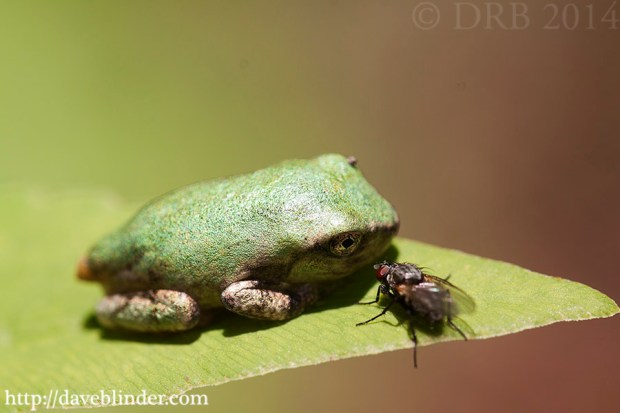
I won’t try to take any credit for getting a fly to land next to this Gray Treefrog metamorph.  I will take credit for being in the right place at the right time and shooting a lot more frames than your average photographer.

dslr macro photography

Chance encounters of the macro type

Photography equipment: Tamron SP 90mm VC F/2.8 1:1 Macro Lens + Canon EOS 50D, handheld.  Shutter speed 1/250 Aperture at F/5.6 ISO 200.  One shot focusing with continuous motor drive active.

Luck was on my side, because the fly got so close to the frog that both of their eyes are in focus.  I actually have a frame where the fly puts one if its feet on the frog’s face, but the whole frame is blurred so that won’t be seeing the light of day.  ….Unless you want to PayPal me $200 🙂

One can never expect unlikely interactions like this to occur, but as Arthur Morris has stated “When unexpected action happens, press the shutter and hope for the best”.  Good advice if you ask me.