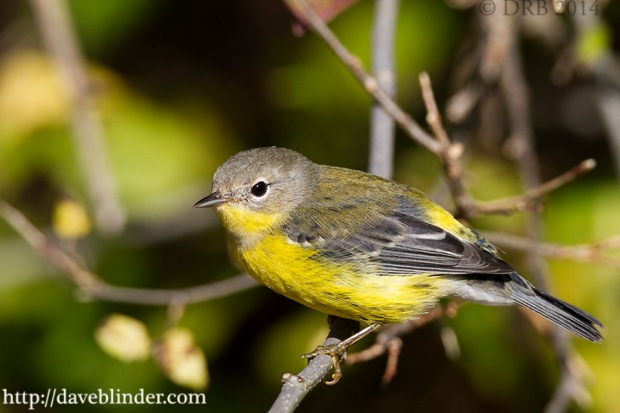
New Jersey Bird Photography: Magnolia Warbler

With a full day for photography ahead of me, I concocted a course of action to head to Sandy Hook National Recreation Area in New Jersey.  Many photographers are drawn to the area for various reasons: portrait shoots on the beach, sunrise/sunset captures, and bird photography.  Tentatively, I blocked off the time in my head… afternoon of chasing around birds and early evening to try some creative sunset images.

I did wind up with several pics that I liked, but this one really stood out to me:

NJ Birding pic

Up close and personal view of a small and vivid woodland songbird, a Magnolia Warbler. Photo taken with the Tamron SP 150-600mm VC lens and the Canon EOS 7D.

The above uncropped telephoto view was taken with the Tamron SP 150-600mm lens and the Canon EOS 7D DSLR.  Exposure settings: 1/1250 F/8 ISO 800

Birdscape: Vulture and Clouds

I went outside for a relatively short duration this morning, and with intermittent clouds and harsh late morning sun I envisioned it as time better spent photographing wildlife than landscapes.  Once I got to my destination I was excited to see three Red-tailed Hawks (our most common Hawk) flying near each other.  Unfortunately, they dispersed quickly so the photo opps were limited.  Shortly thereafter, two Turkey Vultures (common large scavenger) lofted above the treeline and into the clouds.  While not the most graceful or attractive bird, they are interesting in their own right and I will often photograph them if the conditions are right.

Cathartes aura

A Turkey Vulture soars through dramatic clouds in the skies above New Jersey. Image taken with the Tamron SP 150-600mm VC lens and the Canon EOS 7D.

This was my favorite frame of a Vulture flying from today.  I like this angle of its wingspan, and that its flight path is parallel to the seam in the clouds.

Photo taken with the tripod-mounted Tamron SP 150-600mm and the Canon EOS 7D.  Exposure settings: 1/1250 F/10 ISO 100

New Jersey Bird Photography: Bald Eagle

Here is a recent photo taken less than 15 miles from my home.  While Bald Eagles are certainly not abundant in New Jersey, we do have breeding pairs that can be found in many counties.  Expansive habitats like the Delaware River are prime fishing areas for our national bird, but they can survive off of inland lakes and ponds if the conditions are correct.

Haliaeetus leucocephalus

An adult Eagle captured mid-air, this bird was circling a meadow on a warm Fall day in New Jersey. Photographed with the Tamron SP 150-600mm VC lens and the Canon EOS 7D.

Above photo of a Bald Eagle was taken in Morris County, New Jersey.  Equipment included the Tamron SP 150-600mm VC lens and the Canon EOS 7D.  Exposure settings were: 1/200 F/8 ISO 400 @ 600mm.

Name that bird

We had a fairly heavy overcast afternoon today in New Jersey.  While my typical approach to bird photography is to freeze any action, the increased exposure time lent itself much better to creative motion blurs.  I thought I would have some fun with this one, and allow viewers to guess the species name of the bird in the photo below.  It is a composite image, and both birds are the same species.

bif

Motion blur capture of a bird in flight, this a two image composite. Photographed in New Jersey with the Tamron SP 150-600mm VC lens and the Canon EOS 7D.

Any guesses on what type of bird is flying in my frames?

I will disclose the information after I get a good number of guesses.  Photo taken with the Tamron SP 150-600mm VC lens and the Canon EOS 7D in New Jersey.

Image Optimization for Wildlife Photography: Common Yellowthroat

I do get occasionally get asked about my post-processing workflow.  I am an advocate of “getting it right in the camera”, and most of my photographs are presented in a straightforward manner so I spend a trivial amount of time in the “digital darkroom”.  When shooting at higher ISO’s (800 and above), I find the need to apply a little extra TLC to photos.

post-processing before and after

The left side is my photo with my default RAW conversion settings applied. The right side is my final optimized image with additional selective noise reduction and sharpening performed for maximum image quality.

The above side by side view shows my typical RAW file with default settings applied (very light noise reduction and sharpening).  On the right I have gently applied more noise reduction on only the background, and additional sharpening on the bird’s face only.  This took me less than 5 minutes to prepare my photo for web and basic print usage.

NJ bird photo

One of our most common Warblers in New Jersey, here is a striking male in his typical habitat. Photographed with the Tamron SP 150-600mm Lens and the Canon EOS 7D.

The photo above is finalized JPEG for online presentation.  Cropping would increase the apparent signal-to-noise ratio of the image, and I did not feel a crop was in order for this shot.

This male Common Yellowthroat (Geothlypis trichas) was photographed at the Troy Meadows Natural Area in New Jersey.  Photography equipment used includes: Tamron SP 150-600mm VC Lens, Canon EOS 7D DSLR, Manfrotto 055x ProB tripod.

Exposure info: 1/160 F/8 ISO 800

DSLR Nature Cinematography: Snowy Egret

I recently shot a few very short HD DSLR Video clips of one of the more common and easily recognizable wading birds in New Jersey, a Snowy Egret.  My personal goal for wildlife still photography had as been 2 archival quality captures of any subject that I found interesting.  Archival quality captures to me means focus is spot-on, exposure will not require significant post-processing, and the composition is pleasing to my eyes.  I also try to avoid repetition in my photos.  I’ve “upped the ante” on my nature shooting goals, and will now also try to film 1 or 2 quick sequences when I am in the outdoors.

Back to the point, I had been shooting all of my recent photos with a ballhead on my tripod.  Having no experience with fluid tripod heads, but realizing their importance in the video industry I started doing some research.  I already have Manfrotto RC2 quick release plates attached to most of my cameras and lenses so I wanted a fluid head that was designed for the RC2 plate.  I wound up purchasing a Manfrotto 128RC Micro Fluid Head and it has remained atop my 055x ProB tripod ever since.  This allows me to perform the steady panning motions needed for dynamic video work.

The above video was filmed using the Tamron SP 150-600mm VC Lens and the Canon EOS 7D.  Manual video mode settings include: ISO 100 F/14 and the Shutter Speed set to 1/80th.  I muted original audio from the clips in post-processing because of the loud hissing of the wind.  Guitar playing is me strumming my Washburn D10 Guitar, and I ended up recording this with my Samsung cellular phone.  Audio post-processing involved noise reduction, addition of a Phaser Effect, and overall Volume Reduction.  Video post-processing included trimming video segments, cross-fade transitions between shots, contrast enhancements, and split-tone color processing.

Expressing motion in photography: Laughing Gull in flight

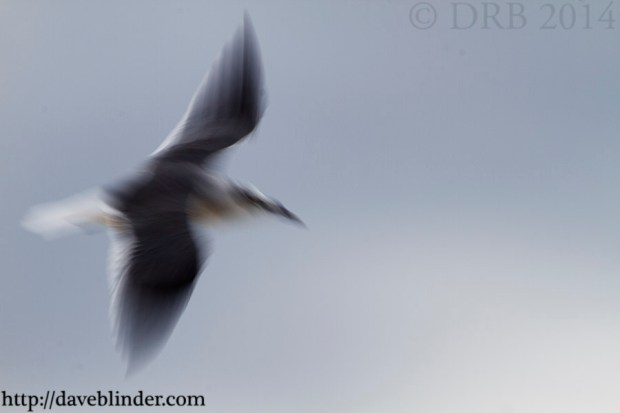
Plenty of terms for the type of DSLR photography illustrated in the main image below and to tell you the truth I don’t even know what to call them.  Panning blurs may be the most logical terminology in my opinion.  Anyways, I often forget how much I enjoy looking at this type of capture.  It seems to boil the bird down to its very essence: shapes and colors.
Larus delawarensis

Photo demonstrating intentional use of a slow shutter speed along with panning of a telephoto lens.

Picture taken using a Canon EOS 7D and the Tamron SP 150-600mm VC telephoto lens.  Tripod lens collar is mounted to Manfrotto 055xProB tripod and Manfrotto junior fluid head.  Camera settings: focal length at 600mm, Manually set shutter at 1/30th, aperture at F/14, ISO 100, Camera RAW, Auto White Balance, VC On, Servo Focus Mode, High Speed Motor Drive.  Photography location: Ocean County, New Jersey.  Atlantic Ocean that is…

This type of photo can sometimes be performed in Aperture Priority mode by using a low ISO and large Aperture number to slow down the shutter.  The shutter speeds that usually work best for me are between 1/13th and 1/50th.  Your mileage may vary.  My goal when preparing for this kind of shot is to get a good amount of definition on the wildlife while emphasizing some motion (in this case the wing beats).  I also want a nice bright exposure that will retain a lot of details in the highlights but still have my histogram as far to the right as possible for maximum detail.  Compositionally speaking, I may be looking to place the bird prominently in the frame without cutting off any appendages or I may want try to include some scenery like showing the bird flying across the water’s surface.  There is a great deal of trial and error in this style of photography.  Patience, persistence, and studying other photog’s successful photos will go a long. way.