Photographing wildlife in harsh lighting: an Eastern Fence Lizard

Below we have a photo of a small, harmless, and downright cute Eastern Fence Lizard.  A native reptile of New Jersey that is widespread within its habitat, but generally not familiar to residents of Northern New Jersey.

Sceloporus undulatus

A closeup photograph of a wild New Jersey reptile taken with a Tamron macro lens and a Canon DSLR.

Photo taken with the Tamron SP 90mm VC F/2.8 Macro Lens and the Canon EOS 7D.  Camera settings: Shutter at 1/100 Aperture at F/3.2 and an ISO speed of 200.  One Shot focus mode, camera handheld, VC On, RAW image format, manual exposure mode, auto white balance.

F/3.2 is not the punchiest aperture of my lens, but it does yield acceptable sharpness.  Shallow depth of field was very important to me in the making of this photo.  My “go to aperture” for macro of F/5.6 brought a lot more detail in the foreground AND the background.  The impact of this photo is in its simplicity and having prominent background shapes and textures strongly detracts from this type of “mid-day silhouette capture”.

Clearly with the sun high in the sky and without cloud cover, the natural illumination of the subject is going to be uneven with a large contrast between the shadows and the highlights.  Many established photographers would call this “bad light” or “problematic light”.  This is not necessarily the easiest condition to create impactful photos in but by manually exposing for the subject’s mid-tones and shooting into an uncluttered background I’ve created a minimalistic photo that evokes thoughts of desert climates.
Bird Photography in Cape May – American Goldfinch

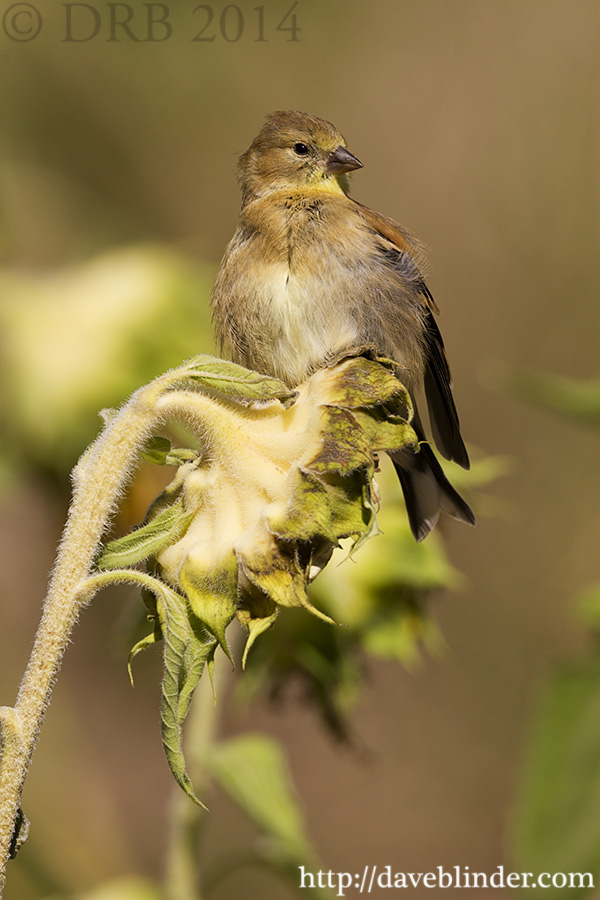
I was recently down in Cape May to do some nature photography.  Since CM is the undisputed birding capital of New Jersey, it only makes sense to take a long telephoto lens along like the Tamron SP 150-600mm VC.  Below is one of my favorite captures from this excursion.

Bird Photography

A closeup view of a female American Goldfinch at rest on a Sunflower in Cape May, New Jersey.

Shutter speed: 1/500 Aperture: F/9.0 ISO: 200 in Aperture Priority Mode +2/3 Exposure Compensation.  The Focal Length is 500mm.  Other settings: VC On, Manfrotto tripod, Spot Metering, Manual White Balance on my Canon EOS 7D

There was a flock of at least 1 or 2 dozen Goldfinches busily feeding in this Sunflower Patch, but upon my approach they retreated to the trees which is the expected response from most songbirds.  Most wildlife is genetically imprinted to flee from humans, as they were historically a food source in the days when hunting was our only means of sustenance.  Experience and literature will tell us that individual bird species have their own expected “flush range”.  Meaning different birds will typically fly away faster than others.  In my personal experience, a very slow but direct approach on a feeding Goldfinch may occasionally get you as close as you want to get.

This particular female American Goldfinch did not fly when the rest of her flock retreated, instead it appeared to me that this bird was mostly basking in the warmth of the sunlight.  She was splitting her time between preening (tending to her feathers) and plucking seeds from the Sunflower head below her.  After years of bird observation, I could tell that this bird was relaxed because it showed no intention of flying away and also lacked the nervous head movements and body twitching that comes before the songbird flushes (flying away).  I got my tripod to the desired photographic height and slowly worked my way forward, one large deliberate by quiet footstep at a time.  The photo featured on this page is not cropped whatsoever and I would not have wanted to shoot it any tighter.  After I was done making my captures I exited the scene in the same slow and deliberate manner to not cause undue stress to the passerine (songbird).

Skateboarding photo from today

I went out with my friend Joe today so that I could challenge myself to some action still and motion footage, his challenge was to land some skateboarding tricks.  There are plenty of variables involved in getting quality extreme sports shots, so I was happy to come home with a few that I liked it.

skateboard trick

Joe popping a skateboard trick off a hip at the skatepark.

Above is a capture of a frontside popshuvit.  I like the frame because you get a nice view of the board in rotation and it’s good some good elevation too!

I was using the Tamron SP 70-200mm VC F/2.8 lens mounted on my Canon EOS 50D.  This combination gives me a fast focusing telephoto lens on a reliable camera with a fast motor drive.  I decided to shoot this frame in a vertical (portrait) orientation, because I think that put more emphasis on the subject in this case.  Other camera settings:  1/1000 shutter with an aperture of F/5.6 and an ISO speed of 200.  I opted for a medium aperture of F/5.6 to get a decent amount of depth of field on Joe but to also provide some separation from the background.  An ISO value of 200 gave me a fast shutter speed, but also provided a nice grain-free image.  The exposure was dialed in manually to give me full control over the ambient lighting.  Tamron’s VC (Vibration Compensation) helped steady the viewfinder for the photo and reduce instances of camera shake.

Dusk at Sunset Beach

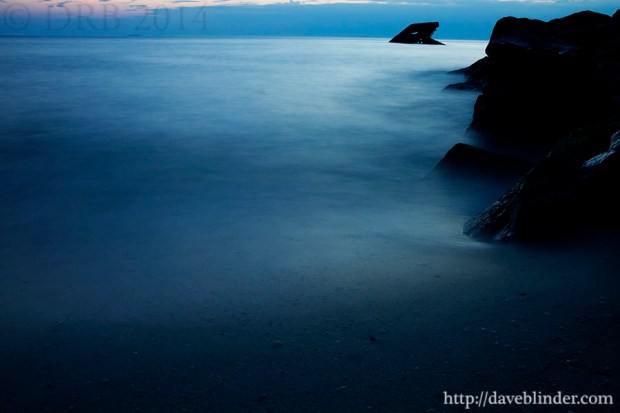
I was doing nature photography in various parts of Cape May this past Thursday, and had a gameplan to head to the well-known Sunset Beach area to try to make some photos of the setting sun.  My plan was foiled as the horizon clouded over as the sun began descending closer and closer to the horizon.

Cape May Dusk

A recent long exposure photo taken in Cape May, New Jersey.

With a fairly bleak sky I shifted my attention and tripod-mounted camera downwards to try to capture the water motion near the tideline.  For this capture, I have a circular 3-stop Neutral Density filter attached to my Tamron 18-270mm VC lens to allow more time for motion within the frame.  The resultant exposure time here was 30 seconds with an aperture of F/13 to have an expansive depth of field.  The ISO value of 100 provides the best image quality possible on current DSLR cameras.

The composition in this image incorporates the rule of thirds to draw the viewer in.  The dark rocks of the jetty occupy roughly 1/3 of the horizontal width of the frame and the sky occupies approximately 1/6 of the vertical height of the frame.  The misty water occupies the vast majority of the scene, but the rocks and the sky give a sense of scale and environment to the scene.

Just another Macro Monday

Sometimes when I head outside to do nature photography, a few nice shots quickly present themselves to me.  Other times, I am outside for hours and the subjects are not cooperating or I just can’t find anything that catches my eye.  3 hours had gone by after lugging around 2 cameras in a local meadow today and it looked like it was time to throw in the towel.  Low and behold, a charismatic insect in a charismatic setting was found while returning to my car.

Ladybug

Asian Lady Beetle atop a white blossom (probably Queen Anne’s Lace).

The above photo was taken with the Tamron SP 90mm VC Macro Lens and a Canon EOS 7D.  It is generally my preference to shoot from a tripod but when your subject is blowing from a breeze I find that a tripod can actually become an obstacle to getting the capture.  The sky had clouded over at this point in the day so I switched the exposure to full manual controls to ensure a proper bright image.  At ISO 400, which I consider my upper threshold for daytime macro shooting, I was still limited to a low shutter speed. 

Choosing a fairly large aperture of F/3.2 allowed more light to hit the camera’s sensor and provided a “dreamy” rendition of the white blossoms.  Composition-wise I thought that executing a vertical photo would create a more dynamic picture and the Beetle is in pretty good compliance with the Rule of Thirds.  I did have to shoot at least a dozen frames with the VC (Vibration Compensation) on.  1/100 of a second is not a very fast shutter speed to freeze a small fragile plant swaying in the breeze and increasing the ISO would degrade the image quality too much for my liking.  Nature photography does take a good deal of tenacity and perseverance in my opinion, but a few sharp shots a day keeps the grumpy Dave’s away.