Butterfly Photography: An American Copper

Several of our local species of butterflies like to rest on whatever flat surface they can find.  I often see butterflies in the middle of dirt trails, dirt roads, and gravel roads.  Probably a nice place to bask for a cold-blooded life form, but not necessarily the ideal scene for a photograph.

Lycaena phlaeas

A closeup view of a small and interestingly marked native butterfly of New Jersey.

DSLR photo of an American Copper butterfly using the Tamron SP 90mm VC 1:1 F/2.8 Macro Lens and the Canon EOS 50 DSLR.  Camera settings in Manual Exposure Mode: Shutter at 1/50th Aperture at F/5.6 and ISO 200.  Autowhite Balance is selected (my typical default), RAW file size, One Shot focusing in Continuous Drive Mode.  VC (in-lens stabilization) On.

This dainty insect is actually sitting on an unattractive dirt trail here, but the camera’s angle of view disguises the surroundings.  To get this view I am lying prone on the ground (a very common posture for good wildlife photographs) and the camera is pressed to my face.  I will often fill the frame as much as possible while trying not to have the subject looked too cramped within the image frame.  I did have to angle the Canon 50D slightly downward to keep the butterfly’s legs in the photo.

Using the “focus and recompose” technique, I pressed the shutter halfway down after initiating autofocus directly on the butterfly’s eye, and then I angled the camera until the lens hood of my macro lens was touching the ground, but the camera body was not.  This low and close-focused perspective has disguised the fact that myself and the butterfly are surrounded by a trail of non-photogenic packed dirt.
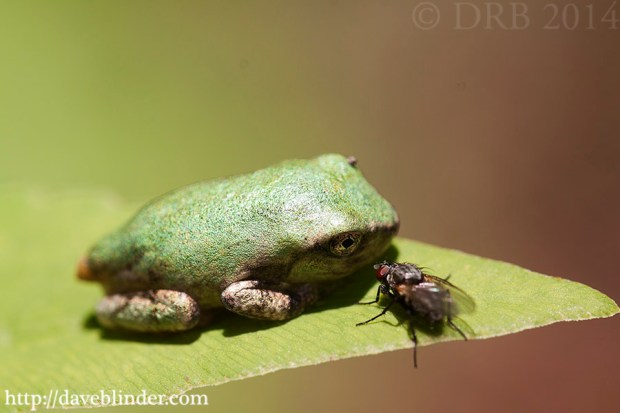
What kind of fly are you?

I won’t try to take any credit for getting a fly to land next to this Gray Treefrog metamorph.  I will take credit for being in the right place at the right time and shooting a lot more frames than your average photographer.

dslr macro photography

Chance encounters of the macro type

Photography equipment: Tamron SP 90mm VC F/2.8 1:1 Macro Lens + Canon EOS 50D, handheld.  Shutter speed 1/250 Aperture at F/5.6 ISO 200.  One shot focusing with continuous motor drive active.

Luck was on my side, because the fly got so close to the frog that both of their eyes are in focus.  I actually have a frame where the fly puts one if its feet on the frog’s face, but the whole frame is blurred so that won’t be seeing the light of day.  ….Unless you want to PayPal me $200 🙂

One can never expect unlikely interactions like this to occur, but as Arthur Morris has stated “When unexpected action happens, press the shutter and hope for the best”.  Good advice if you ask me.

Photographing wildlife in harsh lighting: an Eastern Fence Lizard

Below we have a photo of a small, harmless, and downright cute Eastern Fence Lizard.  A native reptile of New Jersey that is widespread within its habitat, but generally not familiar to residents of Northern New Jersey.

Sceloporus undulatus

A closeup photograph of a wild New Jersey reptile taken with a Tamron macro lens and a Canon DSLR.

Photo taken with the Tamron SP 90mm VC F/2.8 Macro Lens and the Canon EOS 7D.  Camera settings: Shutter at 1/100 Aperture at F/3.2 and an ISO speed of 200.  One Shot focus mode, camera handheld, VC On, RAW image format, manual exposure mode, auto white balance.

F/3.2 is not the punchiest aperture of my lens, but it does yield acceptable sharpness.  Shallow depth of field was very important to me in the making of this photo.  My “go to aperture” for macro of F/5.6 brought a lot more detail in the foreground AND the background.  The impact of this photo is in its simplicity and having prominent background shapes and textures strongly detracts from this type of “mid-day silhouette capture”.

Clearly with the sun high in the sky and without cloud cover, the natural illumination of the subject is going to be uneven with a large contrast between the shadows and the highlights.  Many established photographers would call this “bad light” or “problematic light”.  This is not necessarily the easiest condition to create impactful photos in but by manually exposing for the subject’s mid-tones and shooting into an uncluttered background I’ve created a minimalistic photo that evokes thoughts of desert climates.

Butterfly Photography: Sachem Skippers on Boneset

Closeup photos of butterflies make for effective images because these insects are inherently “cute” or “beautiful” to us homo sapiens.  Probably has to do with their harmless nature or being harbingers of warm weather.  An important part of a quality butterfly photo is a clear view of the insect generally with minimal distractions in the nearby foreground and background.  An attractive perch also makes a world of difference.

mating butterflies

A recent butterfly macro photograph taken in Ocean County, New Jersey.

The above image was taken recently at Jakes Branch County Park in New Jersey.  Equipment used: Tamron SP 90mm VC F/2.8 1:1 Macro Lens and a Canon EOS 7D DSLR.  Handheld photo with the lens-based stabilization (VC) turned on.  Camera settings: 1/160 shutter, F/7.1 ISO 200.  More often than not I will shoot butterflies with an aperture of F/5.6 because it is one of the sharpest apertures of my particular macro lens.  With sufficient planing of the camera, this can get a decent amount of depth of field on the subject as well.  In this case, I decided to go with an aperture of F/7.1 to increase my chances of getting the eyes of both Sachems in focus.  Still not an easy task with 2 moving wildlife subjects.

I shot approximately 12 frames very similar to this one, but each time I would angle the camera body very slightly to the left or right and try to get the eyes of both Skippers aligned to my focus point.  When I magnify this particular frame on my computer I can see the detailed cells of the eyes on both butterflies without blur, so for me this is a keeper.

American Rubyspot damsefly in NJ

This a recent macro insect photo I took in the region of New Jersey known as the Pinelands National Reserve, home to ecosystems and wildlife not often seen in other parts of our state.  Photography equipment utilized: Tamron SP 90mm VC F/2.8 1:1 Macro Lens and the Canon EOS 7D DSLR.  Damselflies are generally smaller than dragonflies, but fall under the same order known as odonata.  Pictured below is a male American Rubyspot damselfly, its Latin name is Hetaerina americana.

NJ insect photo

One of New Jersey’s most vivid damselflies.

I actually ended up wading in standing water that was thigh high to take this photograph.  I saw several Rubyspots perched on vegetation in this pond.  I wasn’t thrilled to get to my cargo shorts soaking wet, but I had to decide to either walk away from a photo opportunity or “dive right into the scene”.

The sunlight was fairly overcast when I snapped this shot so a fast shutter speed was not possible.  Dragging a good tripod into a pond didn’t seem like a good idea, and a tripod is not really an asset when making a still capture of an insect perched on a piece of grass with forces like water ripples and a breeze causing motion.  Handheld and fairly large aperture was the only way this shot was going to happen.

I’ve had a few people tell me that they find a 300mm lens sufficient for shooting small insects, but the reality is you are not going to get this type of highly magnified photo without a 1:1 macro lens.  In this case the fast autofocus and Vibration Compensation were also needed.  Camera settings:  1/125 F/5.0 ISO 400, VC on, Auto White Balance, RAW file format, One Shot focus in continuous drive mode.

Just another Macro Monday

Sometimes when I head outside to do nature photography, a few nice shots quickly present themselves to me.  Other times, I am outside for hours and the subjects are not cooperating or I just can’t find anything that catches my eye.  3 hours had gone by after lugging around 2 cameras in a local meadow today and it looked like it was time to throw in the towel.  Low and behold, a charismatic insect in a charismatic setting was found while returning to my car.

Ladybug

Asian Lady Beetle atop a white blossom (probably Queen Anne’s Lace).

The above photo was taken with the Tamron SP 90mm VC Macro Lens and a Canon EOS 7D.  It is generally my preference to shoot from a tripod but when your subject is blowing from a breeze I find that a tripod can actually become an obstacle to getting the capture.  The sky had clouded over at this point in the day so I switched the exposure to full manual controls to ensure a proper bright image.  At ISO 400, which I consider my upper threshold for daytime macro shooting, I was still limited to a low shutter speed. 

Choosing a fairly large aperture of F/3.2 allowed more light to hit the camera’s sensor and provided a “dreamy” rendition of the white blossoms.  Composition-wise I thought that executing a vertical photo would create a more dynamic picture and the Beetle is in pretty good compliance with the Rule of Thirds.  I did have to shoot at least a dozen frames with the VC (Vibration Compensation) on.  1/100 of a second is not a very fast shutter speed to freeze a small fragile plant swaying in the breeze and increasing the ISO would degrade the image quality too much for my liking.  Nature photography does take a good deal of tenacity and perseverance in my opinion, but a few sharp shots a day keeps the grumpy Dave’s away.

Macro flash and video LED setup

Macro flash and video LED setup

Canon 7D + Tamron 180mm SP Macro lens. A straight flash bracket is attached to the camera body, my Canon Speedlite 270exII is mounted on top of a Giottos mini ballhead. The Speedlite head is covered by my homemade diffuser (actually a plastic coffee “tin”), and today I glued a cold shoe mount on top of the diffuser to mount a Manfrotto ML120 Pocket-12 LED Light for shooting macro videos at night.

Julia

We do get a decent variety of butterflies in the warmer months here in New Jersey, but I always get jealous of the vivid tropical butterflies that I see from the warmer states and tropical countries.  I was fairly successful in shooting some of my target species in Florida, and so here is a Julia, one of them:


Florida butterfly photograph

Julia


Photo taken handheld with the Tamron 90mm VC macro lens mounted on a Canon T2i Rebel camera.  An aperture of F/8 yielded very high sharpness, and acceptable depth of field for a fairly flat subject.


Right Place, Right Time

Sometimes it just pays to be lucky in photography, and that’s pretty much how I came across this wildlife photo opportunity. Anticipating possible action, being prepared, and visualizing how to maximize the opportunity are also very helpful.

Salamander eating

Red Eft and Earthworm

I like to do my photography rounds with two camera bodies ready to shoot and two distinctly different focal lengths. Generally, I will have either a macro lens or a wide angle lens on one DSLR and a longer telephoto lens (400mm) mounted on the other camera. Currently, no all-in-one zoom or all-in-one camera can match the image quality attainable using specialized lenses as standardized charts and personal experience have taught me.

How else can you be prepared? Remove the lens caps in advance, leave your DSLR switched on (they go into convenient standby mode anyways), and have the camera settings attuned to the current ambient lighting situation as best as possible. A formatted memory card and extra batteries are a must for me as well.

Maximizing the opportunity:
Let’s talk about this particular shot. I did not immediately realize there was a tiny amphibian chowing down in front of me as I don’t have superhuman vision, but once I did I knew that I wanted to get in as close possible to emphasize the action, to allow my macro flash setup to illuminate the key elements, and to eliminate the need to crop my final photo and waste valuable megapixels of the image. Cropping reduces the maximum print size of an image, and also emphasizes imperfections like noise (film grain).

Luck?  Well you’re one your own with that one.