
Plenty of terms for the type of DSLR photography illustrated in the main image below and to tell you the truth I don’t even know what to call them. Panning blurs may be the most logical terminology in my opinion. Anyways, I often forget how much I enjoy looking at this type of capture. It seems to boil the bird down to its very essence: shapes and colors.
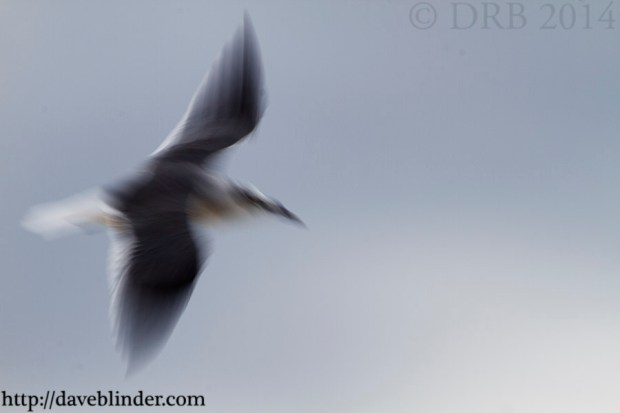
Photo demonstrating intentional use of a slow shutter speed along with panning of a telephoto lens.
Picture taken using a Canon EOS 7D and the Tamron SP 150-600mm VC telephoto lens. Tripod lens collar is mounted to Manfrotto 055xProB tripod and Manfrotto junior fluid head. Camera settings: focal length at 600mm, Manually set shutter at 1/30th, aperture at F/14, ISO 100, Camera RAW, Auto White Balance, VC On, Servo Focus Mode, High Speed Motor Drive. Photography location: Ocean County, New Jersey. Atlantic Ocean that is…
This type of photo can sometimes be performed in Aperture Priority mode by using a low ISO and large Aperture number to slow down the shutter. The shutter speeds that usually work best for me are between 1/13th and 1/50th. Your mileage may vary. My goal when preparing for this kind of shot is to get a good amount of definition on the wildlife while emphasizing some motion (in this case the wing beats). I also want a nice bright exposure that will retain a lot of details in the highlights but still have my histogram as far to the right as possible for maximum detail. Compositionally speaking, I may be looking to place the bird prominently in the frame without cutting off any appendages or I may want try to include some scenery like showing the bird flying across the water’s surface. There is a great deal of trial and error in this style of photography. Patience, persistence, and studying other photog’s successful photos will go a long. way.
 Dave Blinder Nature Photography