New Jersey Art Photography: Bridge Pentaptych

I will admit that I didn’t know Pentaptych was a word until I researched the terminology tonight.  I still struggle to spell the word correctly after reading its definition online.  I’d tried to to shoot with the intentions of creating a triptych in the past, but the images lacked enough continuity for me to piece them together.  The photos shown below were taken in a sequence, and the exposure and focal length are constant.  The variable is the focusing of the lens, which I changed manually between each shot.  All five individual images were taken with the Tamron 16-300mm VC All-In-One lens and the tripod-mounted Canon EOS M mirrorless camera.

NJ Art Photo Sequence

Five frame sequence displayed together to form a cohesive pentaptych. Closeup views of a bridge at midday. All photographs taken with the Tamron 16-300mm VC All-In-One lens and the Canon EOS M mirrorless camera.

Exposure settings: 4s F/9.0 ISO 100, 300mm.

New Jersey Art Photography: In-camera Double Exposures

The past few days I’ve been immersing my creativity in executing in-camera double exposures to capture “scenes within a scenes” with the intention of introducing the element of mystery to my nature photography.  I often find myself shooting each composition no less than ten individual frames, and after that I will see if a slightly different composition works better.  My goals for each photo are to have a good balance of detail, but also a compelling tonal range, and a balance of negative and positive space.  Post-processing is minimal.  Contrast seasoned to taste, perhaps a slight white balance shift (coming from Auto White Balance), and very soft-handed sharpening/noise reduction.

Both below images were taken with the mirrorless Canon EOS M digital camera and the Tamron 16-300mm VC All-In-One lens.

New Jersey Art Photography

Single image capture of a rusty metal footbridge and a quick zoom outward to reveal the trail to the footbridge.

Exposure settings: 25s F/16 ISO 100

NJ Photographic Art

Singe image capture of reflected trees with a quick zoom outward to reveal a broader view of the stream.

Exposure settings: 15s F/8.0 ISO 100

Impressionist Photography: Beech Leaves

In the vast majority of my photographs, I’ve striven to make at least one element as sharp as possible.  I think there is certainly validity in that technique, but perhaps there can be greater validity to intentionally make no elements in the frame sharply defined.  Why do this?  Maybe it can create photo art that is more unique and personalized.  These camera techniques are very far from new, but I believe there are nuances within the techniques yet to be fully explored.

New Jersey Art Photography

A softly rendered view of large trees covered in orange colored leaves in late Autumn. Photo taken with the Tamron 16-300mm VC All-In-One lens and the Canon 7D.

The above photo was taken handheld with the Tamron 16-300mm VC All-In-One lens and the Canon EOS 7D.  Exposure settings: 1.6s F/14 ISO 100, 18mm.

Motion Blurs in Photography: How Much is Too Much?

…or how little is too little.  Quite a subjective topic, and of course there are no laws in the arts while “rules” are merely guides.  Having done a lot of nature photography in the past seven-odd years, I generally find that my first impression when proofing my own photos is what appeals most to me aesthetically even in the long run.  Do viewers and peers share my visual preferences?  I’m not sure.  Please do feel free to tell me how you feel about these photos in my comments section.

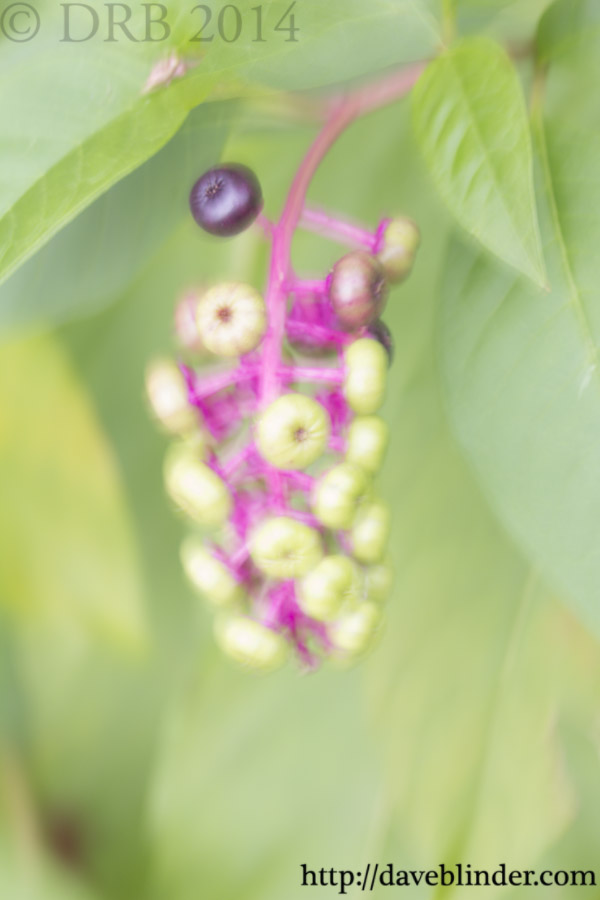
Today’s subject material ended up being the common Pokeweed plant.  I haven’t done many abstract closeup photos before, so I tried some different camera motions to try to coincide with the shape of the berries and stem.  All photos taken with the Tamron SP 90mm VC F/2.8 1:1 Macro Lens and the Canon EOS 60D, handheld.

#1 – My finalized photo:

NJ Fine Art Abstract Photo

Optimized image with intentional camera movement, ICM.

Settings for above photo: 1/5th F/11 ISO 100.  A slight circular motion of the camera was made.

#2 A split screen comparison of the SOOC shot versus my end product:

photoshop comparison

Lower left is the straight out of camera shot, upper right is what I deemed to have a good amount of contrast for web viewing.

#3 An outtake, not enough motion makes this look sloppy to me

Phytolacca americana

A slow hand movement has rendered a fair amount of sharpness on the subject but still left faint signs of blur.

Above photo settings: 1/5th F/11 ISO 100.  Camera was moved in a slow fashion.

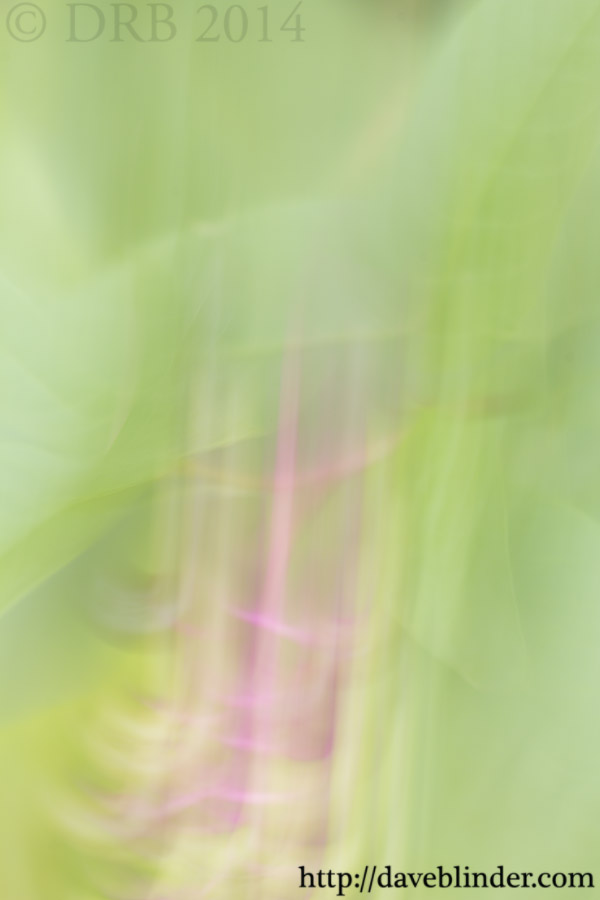
#4 Another outtake.  To me, the subject is unidentifiable and this photo lacks a sense of order:

very blurry view of foliage

Created with a very fast downward motion of the camera as the shutter was closing.

Above photo settings: 1/5th F/11 ISO 100.  Camera was moved in a very quick fashion.

Which do you think looks best?