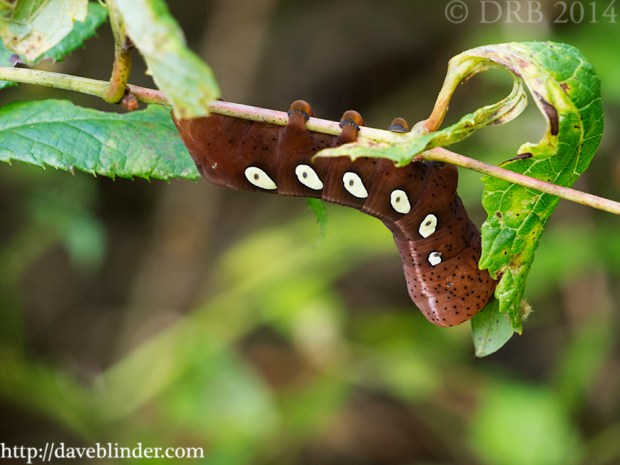
Pandora Sphinx Moth Caterpillar

This photo was taken recently in Morris County, New Jersey.  I can’t identify many caterpillars “off the cuff”, and I was pretty sure this was one I had never seen before.  Whenever possible I put some effort into putting the proper common name to any insect, bird, or plant that I take pictures of.  The hardest IDs for me are moths and nondescript plants.  Often I will “throw in the towel”, and ask someone else for help in identifying the organism.  My Google Search for “brown caterpillar with green spots” eventually led me to a dead ringer for this one, a Pandora Sphinx Moth Caterpillar, luckily for me a distinctive larva.
Eumorpha pandorus photo

Micro Four-Thirds photograph of a large brown and green caterpillar feeding.

Photo taken with the Tamron 14-150mm f/3.5-5.8 Di III Lens and the Olympus PEN E-PL2 Micro Four-Thirds Digital Camera mounted on my Manfrotto 055xProB tripod.  Settings: 150mm focal length, 1/20th shutter, aperture at F/8, ISO 400.  One Shot focus with continuous motor drive, Image Stabilization Mode 1 (in camera), RAW image format.  Less than 5% of the image was cropped off because of a very distracting leaf hitting the frame of the image.

I prefocused the lens on some nearby leaves, which allowed the lens to find the caterpillar faster than going through its entire focal range.  My subject was pretty stationary and I felt confident that I had a few moments to spare so I bent down a couple of leaves in the background to eliminate a little clutter.  I’d still prefer better separation from the background and foreground, but such is the way of nature photography, you take what you can get and make the best of it.

Butterfly Photography: An American Copper

Several of our local species of butterflies like to rest on whatever flat surface they can find.  I often see butterflies in the middle of dirt trails, dirt roads, and gravel roads.  Probably a nice place to bask for a cold-blooded life form, but not necessarily the ideal scene for a photograph.

Lycaena phlaeas

A closeup view of a small and interestingly marked native butterfly of New Jersey.

DSLR photo of an American Copper butterfly using the Tamron SP 90mm VC 1:1 F/2.8 Macro Lens and the Canon EOS 50 DSLR.  Camera settings in Manual Exposure Mode: Shutter at 1/50th Aperture at F/5.6 and ISO 200.  Autowhite Balance is selected (my typical default), RAW file size, One Shot focusing in Continuous Drive Mode.  VC (in-lens stabilization) On.

This dainty insect is actually sitting on an unattractive dirt trail here, but the camera’s angle of view disguises the surroundings.  To get this view I am lying prone on the ground (a very common posture for good wildlife photographs) and the camera is pressed to my face.  I will often fill the frame as much as possible while trying not to have the subject looked too cramped within the image frame.  I did have to angle the Canon 50D slightly downward to keep the butterfly’s legs in the photo.

Using the “focus and recompose” technique, I pressed the shutter halfway down after initiating autofocus directly on the butterfly’s eye, and then I angled the camera until the lens hood of my macro lens was touching the ground, but the camera body was not.  This low and close-focused perspective has disguised the fact that myself and the butterfly are surrounded by a trail of non-photogenic packed dirt.

What kind of fly are you?

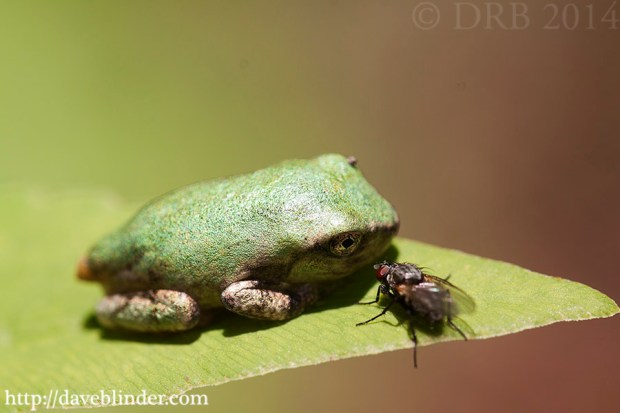
I won’t try to take any credit for getting a fly to land next to this Gray Treefrog metamorph.  I will take credit for being in the right place at the right time and shooting a lot more frames than your average photographer.

dslr macro photography

Chance encounters of the macro type

Photography equipment: Tamron SP 90mm VC F/2.8 1:1 Macro Lens + Canon EOS 50D, handheld.  Shutter speed 1/250 Aperture at F/5.6 ISO 200.  One shot focusing with continuous motor drive active.

Luck was on my side, because the fly got so close to the frog that both of their eyes are in focus.  I actually have a frame where the fly puts one if its feet on the frog’s face, but the whole frame is blurred so that won’t be seeing the light of day.  ….Unless you want to PayPal me $200 🙂

One can never expect unlikely interactions like this to occur, but as Arthur Morris has stated “When unexpected action happens, press the shutter and hope for the best”.  Good advice if you ask me.

Photographing wildlife in harsh lighting: an Eastern Fence Lizard

Below we have a photo of a small, harmless, and downright cute Eastern Fence Lizard.  A native reptile of New Jersey that is widespread within its habitat, but generally not familiar to residents of Northern New Jersey.

Sceloporus undulatus

A closeup photograph of a wild New Jersey reptile taken with a Tamron macro lens and a Canon DSLR.

Photo taken with the Tamron SP 90mm VC F/2.8 Macro Lens and the Canon EOS 7D.  Camera settings: Shutter at 1/100 Aperture at F/3.2 and an ISO speed of 200.  One Shot focus mode, camera handheld, VC On, RAW image format, manual exposure mode, auto white balance.

F/3.2 is not the punchiest aperture of my lens, but it does yield acceptable sharpness.  Shallow depth of field was very important to me in the making of this photo.  My “go to aperture” for macro of F/5.6 brought a lot more detail in the foreground AND the background.  The impact of this photo is in its simplicity and having prominent background shapes and textures strongly detracts from this type of “mid-day silhouette capture”.

Clearly with the sun high in the sky and without cloud cover, the natural illumination of the subject is going to be uneven with a large contrast between the shadows and the highlights.  Many established photographers would call this “bad light” or “problematic light”.  This is not necessarily the easiest condition to create impactful photos in but by manually exposing for the subject’s mid-tones and shooting into an uncluttered background I’ve created a minimalistic photo that evokes thoughts of desert climates.

Butterfly Photography: Sachem Skippers on Boneset

Closeup photos of butterflies make for effective images because these insects are inherently “cute” or “beautiful” to us homo sapiens.  Probably has to do with their harmless nature or being harbingers of warm weather.  An important part of a quality butterfly photo is a clear view of the insect generally with minimal distractions in the nearby foreground and background.  An attractive perch also makes a world of difference.

mating butterflies

A recent butterfly macro photograph taken in Ocean County, New Jersey.

The above image was taken recently at Jakes Branch County Park in New Jersey.  Equipment used: Tamron SP 90mm VC F/2.8 1:1 Macro Lens and a Canon EOS 7D DSLR.  Handheld photo with the lens-based stabilization (VC) turned on.  Camera settings: 1/160 shutter, F/7.1 ISO 200.  More often than not I will shoot butterflies with an aperture of F/5.6 because it is one of the sharpest apertures of my particular macro lens.  With sufficient planing of the camera, this can get a decent amount of depth of field on the subject as well.  In this case, I decided to go with an aperture of F/7.1 to increase my chances of getting the eyes of both Sachems in focus.  Still not an easy task with 2 moving wildlife subjects.

I shot approximately 12 frames very similar to this one, but each time I would angle the camera body very slightly to the left or right and try to get the eyes of both Skippers aligned to my focus point.  When I magnify this particular frame on my computer I can see the detailed cells of the eyes on both butterflies without blur, so for me this is a keeper.

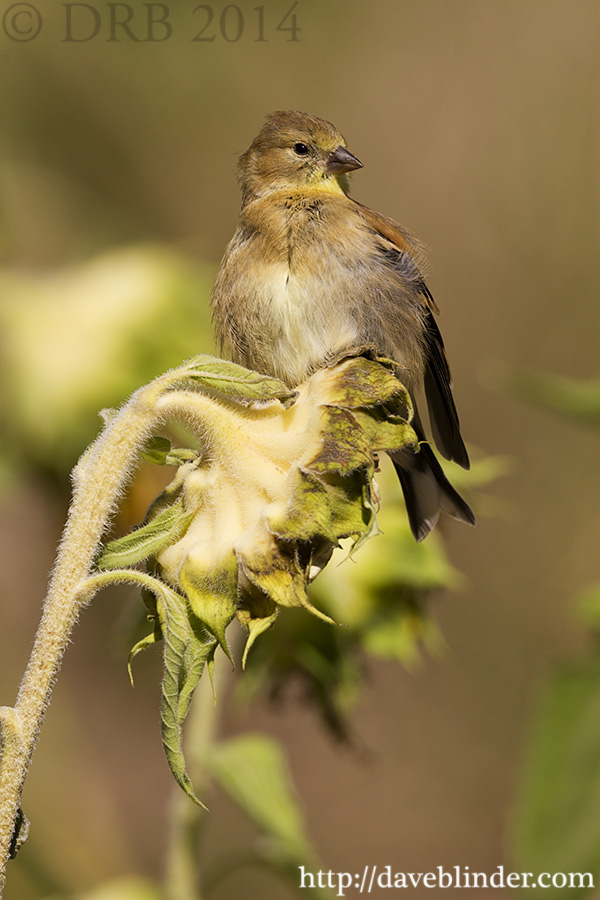
Bird Photography in Cape May – American Goldfinch

I was recently down in Cape May to do some nature photography.  Since CM is the undisputed birding capital of New Jersey, it only makes sense to take a long telephoto lens along like the Tamron SP 150-600mm VC.  Below is one of my favorite captures from this excursion.

Bird Photography

A closeup view of a female American Goldfinch at rest on a Sunflower in Cape May, New Jersey.

Shutter speed: 1/500 Aperture: F/9.0 ISO: 200 in Aperture Priority Mode +2/3 Exposure Compensation.  The Focal Length is 500mm.  Other settings: VC On, Manfrotto tripod, Spot Metering, Manual White Balance on my Canon EOS 7D

There was a flock of at least 1 or 2 dozen Goldfinches busily feeding in this Sunflower Patch, but upon my approach they retreated to the trees which is the expected response from most songbirds.  Most wildlife is genetically imprinted to flee from humans, as they were historically a food source in the days when hunting was our only means of sustenance.  Experience and literature will tell us that individual bird species have their own expected “flush range”.  Meaning different birds will typically fly away faster than others.  In my personal experience, a very slow but direct approach on a feeding Goldfinch may occasionally get you as close as you want to get.

This particular female American Goldfinch did not fly when the rest of her flock retreated, instead it appeared to me that this bird was mostly basking in the warmth of the sunlight.  She was splitting her time between preening (tending to her feathers) and plucking seeds from the Sunflower head below her.  After years of bird observation, I could tell that this bird was relaxed because it showed no intention of flying away and also lacked the nervous head movements and body twitching that comes before the songbird flushes (flying away).  I got my tripod to the desired photographic height and slowly worked my way forward, one large deliberate by quiet footstep at a time.  The photo featured on this page is not cropped whatsoever and I would not have wanted to shoot it any tighter.  After I was done making my captures I exited the scene in the same slow and deliberate manner to not cause undue stress to the passerine (songbird).

Skateboarding photo from today

I went out with my friend Joe today so that I could challenge myself to some action still and motion footage, his challenge was to land some skateboarding tricks.  There are plenty of variables involved in getting quality extreme sports shots, so I was happy to come home with a few that I liked it.

skateboard trick

Joe popping a skateboard trick off a hip at the skatepark.

Above is a capture of a frontside popshuvit.  I like the frame because you get a nice view of the board in rotation and it’s good some good elevation too!

I was using the Tamron SP 70-200mm VC F/2.8 lens mounted on my Canon EOS 50D.  This combination gives me a fast focusing telephoto lens on a reliable camera with a fast motor drive.  I decided to shoot this frame in a vertical (portrait) orientation, because I think that put more emphasis on the subject in this case.  Other camera settings:  1/1000 shutter with an aperture of F/5.6 and an ISO speed of 200.  I opted for a medium aperture of F/5.6 to get a decent amount of depth of field on Joe but to also provide some separation from the background.  An ISO value of 200 gave me a fast shutter speed, but also provided a nice grain-free image.  The exposure was dialed in manually to give me full control over the ambient lighting.  Tamron’s VC (Vibration Compensation) helped steady the viewfinder for the photo and reduce instances of camera shake.

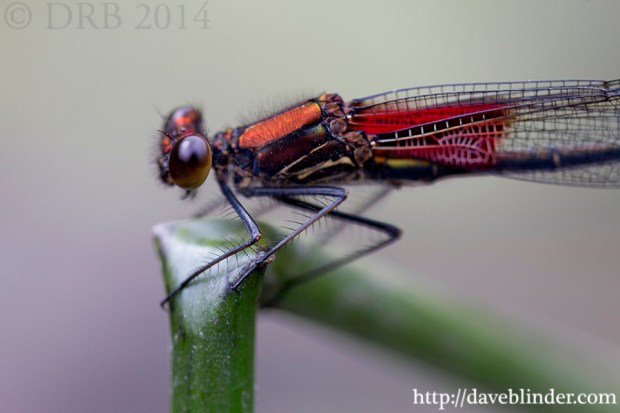
American Rubyspot damsefly in NJ

This a recent macro insect photo I took in the region of New Jersey known as the Pinelands National Reserve, home to ecosystems and wildlife not often seen in other parts of our state.  Photography equipment utilized: Tamron SP 90mm VC F/2.8 1:1 Macro Lens and the Canon EOS 7D DSLR.  Damselflies are generally smaller than dragonflies, but fall under the same order known as odonata.  Pictured below is a male American Rubyspot damselfly, its Latin name is Hetaerina americana.

NJ insect photo

One of New Jersey’s most vivid damselflies.

I actually ended up wading in standing water that was thigh high to take this photograph.  I saw several Rubyspots perched on vegetation in this pond.  I wasn’t thrilled to get to my cargo shorts soaking wet, but I had to decide to either walk away from a photo opportunity or “dive right into the scene”.

The sunlight was fairly overcast when I snapped this shot so a fast shutter speed was not possible.  Dragging a good tripod into a pond didn’t seem like a good idea, and a tripod is not really an asset when making a still capture of an insect perched on a piece of grass with forces like water ripples and a breeze causing motion.  Handheld and fairly large aperture was the only way this shot was going to happen.

I’ve had a few people tell me that they find a 300mm lens sufficient for shooting small insects, but the reality is you are not going to get this type of highly magnified photo without a 1:1 macro lens.  In this case the fast autofocus and Vibration Compensation were also needed.  Camera settings:  1/125 F/5.0 ISO 400, VC on, Auto White Balance, RAW file format, One Shot focus in continuous drive mode.

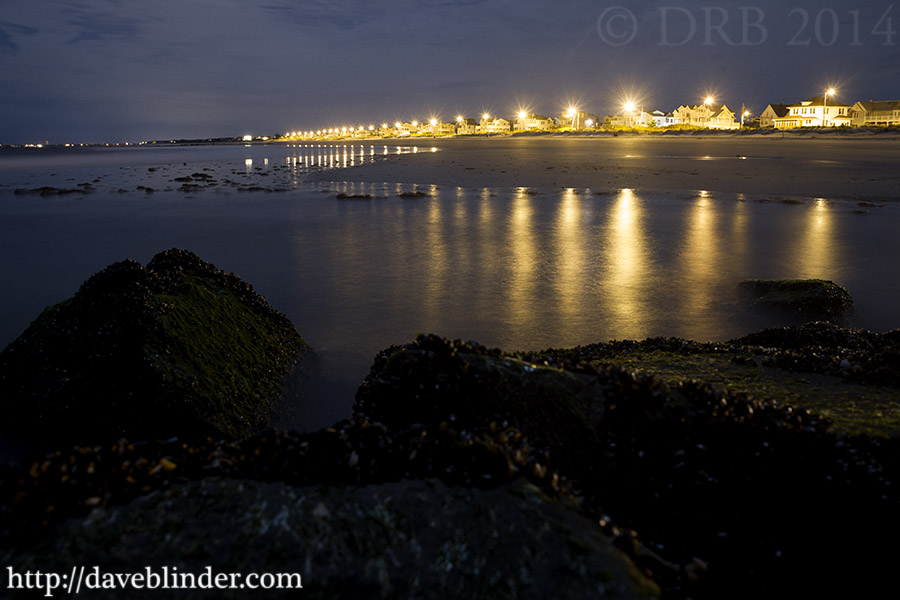
Sea Isle Reflections

This is an impromptu composition that was dictated by the lighting conditions.  My intention for this night photography session was to photograph stars in the sky, but the punchy light from the moon and the promenade limited the definition possible in the sky.

Fine Art Landscape Photo

Fine Art Photograph taken at night at the Jersey Shore in Sea Isle City

The camera settings here are a focal length of 18mm, aperture at F/5.6 and ISO speed of 400.  Increasing the exposure would have blown out the highlights and decreasing the exposure would have rendered the scene too dark for my tastes.  I originally started off at a higher ISO but the image looked washed out so I lowered it a full ISO stop.  I do not shoot still photos in incremental ISO’s as anything other than native ISO values can deteriorate dynamic range or image quality.  Other settings: RAW file format, Auto White Balance, Mirror Lock Up, 2 Second Timer, VC (stabilization) off, tripod firmly in the sand

The composition in this photo is a pretty straight-forward rule-of-thirds setup.  The horizon is placed about 1/3 of the way down from the top of the frame and the houses occupy approximately 2/3 of the horizontal length of the frame.  Putting those elements dead center in the photo would have killed the dynamics in my opinion.

American Goldfinch DSLR video; filmed in Cape May, New Jersey

It was a real treat to get some close footage of our vibrant state bird recently.  I knew that I would want footage from several different angles to create diversity… even in a short wildlife video.  Varying the focal lengths and my angle of view on the birds was how I tackled that challenge.

Footage shot in 1080p at 30fps on the Canon EOS 7D with the tripod mounted Tamron SP 150-600mm VC zoom lens.  DSLR was set to the desired shutter speed of 1/60th of a second and I adjusted the aperture and ISO value to get as good of an exposure as possible for each clip.  Unfortunately it was a windy day so I had to strip the audio of the birds interacting and feeding.  I don’t think anyone would have enjoyed listening to the hissing and popping caused by the wind hitting the microphone outdoors.