Expressing motion in photography: Beach Grass and Crescent Moon

When I first began doing photography, I thought that the prime objective was to freeze all action to record a moment in time.  Getting a sharp capture of a fleeting moment can indeed be difficult, whether it is a closeup view of the supermoon rising on the horizon, a sports photograph like a MLB baseball player nailing a fastball, or a bird photo like trying to shoot a tiny Tree Swallow mid-air.  There is also great validity to having motion within your frame.  In some cases, this can evoke moods like quickly fleeting action or on the other hand, serenity.
NJ Shore Night Photo

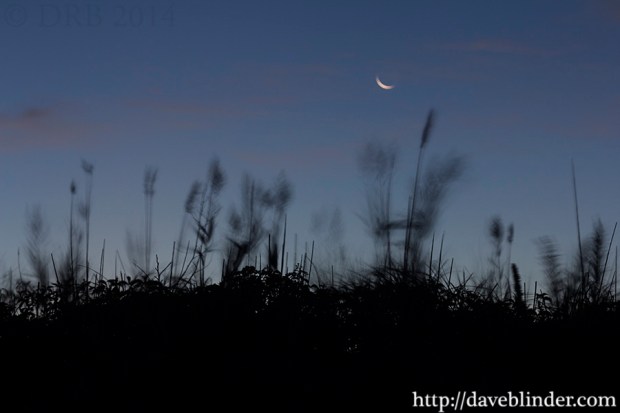
DSLR Nature Photograph from New Jersey showcasing how motion caused by wind can express time and add further dynamics to an image.

The above image was taken recently at the New Jersey Shore using a tripod-mounted Canon EOS 60D camera and the Tamron SP 90mm VC 1:1 F/2.8 Macro Lens.  Camera settings in manual exposure: 2.5 seconds F/7.1 ISO 100.  VC off (lens stabilization motor), Mirror Lock-up, 2 Second Timer, One Shot Autofocus (near the middle of the grass), and Auto White Balance.

I think the crescent moon has a really great distinctive shape, a shape I generally associate with a peaceful sky.  The grass that I have included within the frame is typical vegetation of the mid-Atlantic shoreline, so this gives a nice sense of orientation for the viewer.  For others, the grass may be reminiscent of a prairie or meadow.  The back and forth motion of the blades of grass tell us that time is passing, and also gives the photo a much softer edged appearance than a motionless capture.  I did shoot several similar frames, but in the other images I actually felt there was too much motion and not enough definition on the grass.

Sea Isle Reflections

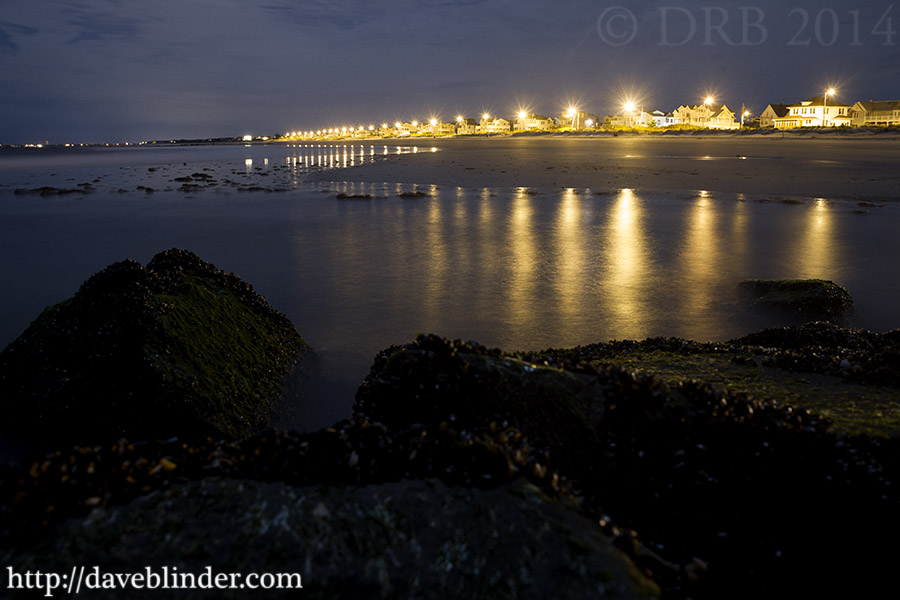
This is an impromptu composition that was dictated by the lighting conditions.  My intention for this night photography session was to photograph stars in the sky, but the punchy light from the moon and the promenade limited the definition possible in the sky.

Fine Art Landscape Photo

Fine Art Photograph taken at night at the Jersey Shore in Sea Isle City

The camera settings here are a focal length of 18mm, aperture at F/5.6 and ISO speed of 400.  Increasing the exposure would have blown out the highlights and decreasing the exposure would have rendered the scene too dark for my tastes.  I originally started off at a higher ISO but the image looked washed out so I lowered it a full ISO stop.  I do not shoot still photos in incremental ISO’s as anything other than native ISO values can deteriorate dynamic range or image quality.  Other settings: RAW file format, Auto White Balance, Mirror Lock Up, 2 Second Timer, VC (stabilization) off, tripod firmly in the sand

The composition in this photo is a pretty straight-forward rule-of-thirds setup.  The horizon is placed about 1/3 of the way down from the top of the frame and the houses occupy approximately 2/3 of the horizontal length of the frame.  Putting those elements dead center in the photo would have killed the dynamics in my opinion.

Dusk at Sunset Beach

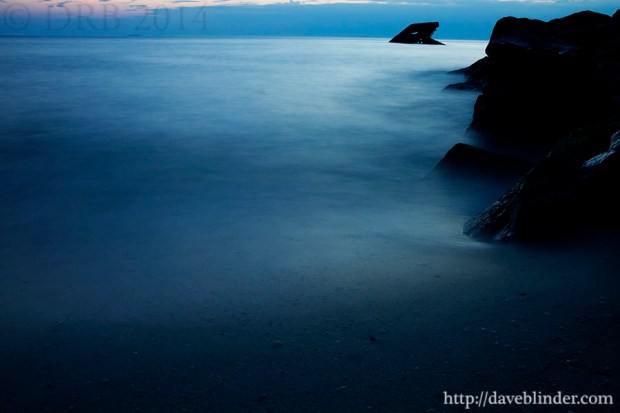
I was doing nature photography in various parts of Cape May this past Thursday, and had a gameplan to head to the well-known Sunset Beach area to try to make some photos of the setting sun.  My plan was foiled as the horizon clouded over as the sun began descending closer and closer to the horizon.

Cape May Dusk

A recent long exposure photo taken in Cape May, New Jersey.

With a fairly bleak sky I shifted my attention and tripod-mounted camera downwards to try to capture the water motion near the tideline.  For this capture, I have a circular 3-stop Neutral Density filter attached to my Tamron 18-270mm VC lens to allow more time for motion within the frame.  The resultant exposure time here was 30 seconds with an aperture of F/13 to have an expansive depth of field.  The ISO value of 100 provides the best image quality possible on current DSLR cameras.

The composition in this image incorporates the rule of thirds to draw the viewer in.  The dark rocks of the jetty occupy roughly 1/3 of the horizontal width of the frame and the sky occupies approximately 1/6 of the vertical height of the frame.  The misty water occupies the vast majority of the scene, but the rocks and the sky give a sense of scale and environment to the scene.